Air Duct Cleaning on Long Island: When to Do It and What to Expect
NADCA standards, post-renovation cleaning, signs your ducts need work, cost ranges for Nassau and Suffolk, dryer vent fire risk, and how to spot a bait-and-switch quote.
Why air duct cleaning is different on Long Island
Long Island's housing stock and climate create duct-cleaning conditions that differ meaningfully from national averages. The bulk of Nassau and Suffolk County homes were built between 1950 and 1975 — Levittown-era construction in Nassau, the Route 25A corridor in Suffolk — using galvanized sheet-metal ductwork that was often installed in unconditioned attic and crawl-space runs. Six decades of dust, pollen, pet dander, and humidity migration accumulate in these systems. Salt air from the south shore accelerates metal corrosion, and Long Island's high-humidity summers — particularly South Shore towns from Freeport to Patchogue — promote mold spore growth inside supply trunk lines near the evaporator coil.
Add to this the 2012 Sandy remediation wave, which put replacement ductwork into tens of thousands of homes, much of which is now 12–14 years old and approaching its first meaningful cleaning cycle. And new construction across Nassau County brings post-renovation debris — drywall dust, insulation fibers, paint particulates — that NADCA specifically identifies as a cleaning trigger regardless of the duct's age.
NADCA standards: what a proper cleaning actually requires
NADCA (National Air Duct Cleaners Association) defines what a proper residential duct cleaning looks like in its ACR (Assessment, Cleaning, and Restoration) standard. The key requirements: a HEPA-equipped negative-air machine connected to the main return trunk to create airflow through the system, mechanical agitation of every supply and return line (rotary brush, compressed-air whip, or contact vacuum), HEPA vacuuming of all accessible debris, and inspection and cleaning of the air handler — blower wheel, evaporator coil, and drain pan.
What the ACR standard explicitly does not allow: cleaning only the register covers closest to the floor. Spot-cleaning 3–4 registers and calling it done. "Sanitizing" sprays applied without mechanical debris removal. The $99 and $149 whole-house specials advertised by out-of-state fleets operating in Nassau and Suffolk County are almost universally NADCA non-compliant. A real NADCA-compliant residential cleaning on a 1,500 square foot Long Island home takes 3–5 hours and costs $450–$1,100. It cannot be done correctly in 45 minutes.
Signs your ducts need cleaning
The clearest signs that your Long Island home's ducts need professional cleaning: visible dust blowing from supply registers when the system starts, a musty or dusty odor that's stronger when the HVAC is running, allergy or asthma symptoms that improve when family members spend time outside the house, dusty return grille covers that reload within days of cleaning, visible mold or discoloration inside an accessible register opening, or it has been more than 4–5 years since the last professional cleaning.
Signs that are less conclusive: a single dusty register (can be a filter issue), occasional mild odor (might be drain pan, not ducts), new home purchase (clean the ducts as a baseline regardless of what the previous owners say). For any post-renovation situation — finished basement, kitchen gut, addition — NADCA recommends cleaning immediately after construction regardless of time elapsed since last cleaning, because renovation debris gets pulled into the return side of the HVAC system continuously during the work.
Post-renovation cleaning: the most overlooked trigger
Renovation work is the single most overlooked duct cleaning trigger among Long Island homeowners. Drywall compound dust is the worst offender: it's fine enough to pass through standard 1-inch filters, and it coats the interior of return ducts, trunk lines, and blower wheels. Kitchen gut renovations in Nassau County homes — common in the 2024–2026 renovation boom — push plaster, tile adhesive, and flooring adhesive particulates into the HVAC return. Finished basement conversions in Suffolk County introduce drywall dust, paint atomization, and sometimes insulation fibers into every room connected to the system.
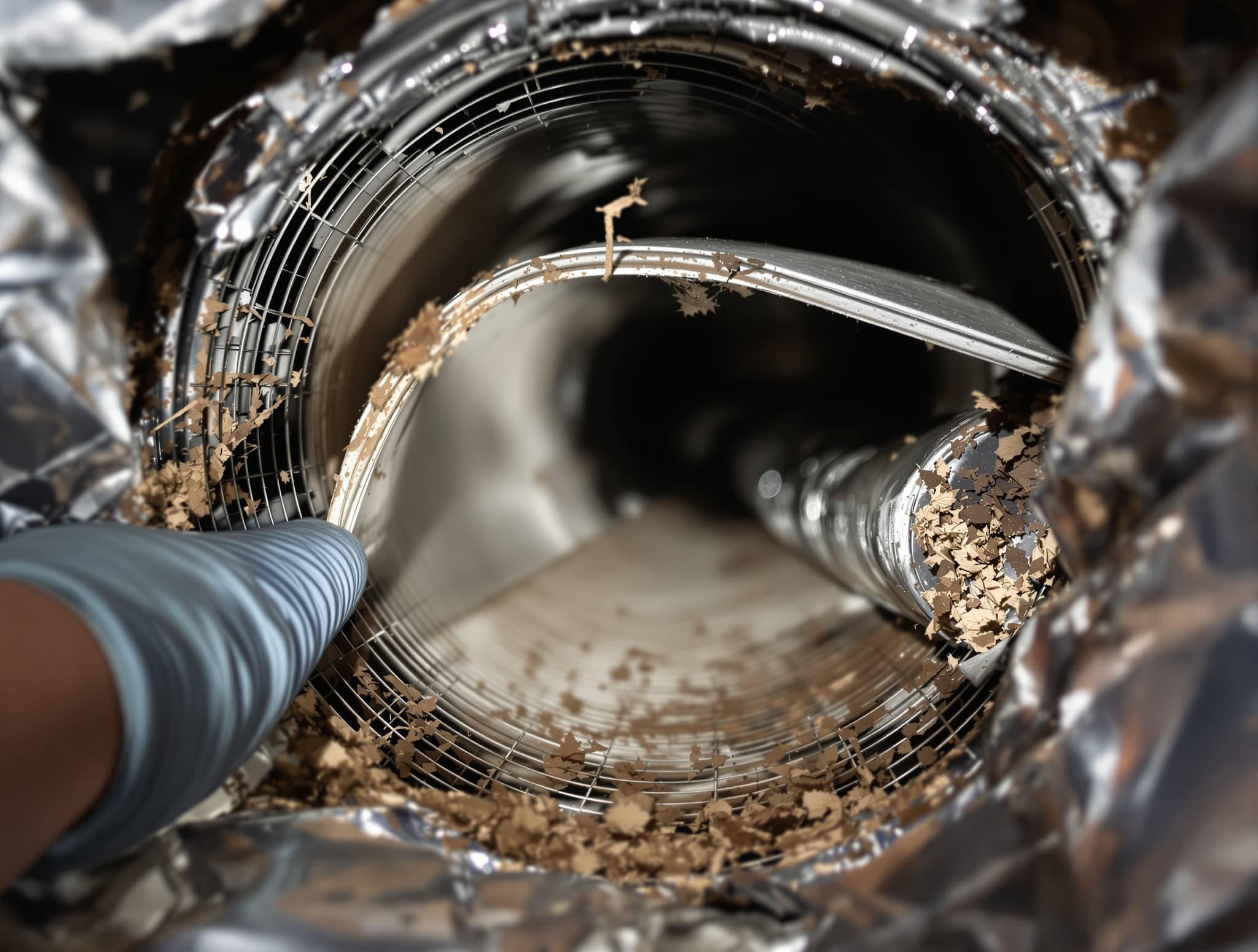
Even with plastic sheeting over return registers during construction, fine dust migration is substantial. Camera-scope the returns after any major renovation — you will see the evidence. NADCA's position is that post-construction cleaning is not optional; it's required to remove what the construction introduced. Long Island homeowners who skip this step often spend years treating allergy symptoms that disappear immediately after a proper post-renovation clean.
Nassau vs Suffolk: cost and scheduling differences
Air duct cleaning prices on Long Island run slightly higher in Nassau County than Suffolk on average, driven by higher contractor overhead costs in Nassau (license fees, van operating costs near the Queens border, and more traffic affecting scheduling density). A typical Nassau County residential clean — 2-zone system, 14 vents, 1,800 sq ft home — runs $550–$900. The same home in mid-Suffolk (Smithtown, Commack, Hauppauge) typically runs $475–$800. East End Suffolk (Hamptons, North Fork) often runs the same or slightly higher than Nassau due to travel premium.
Scheduling windows differ too. Nassau County crews book 4–6 weeks out in spring (March–May), which is peak season. Suffolk County crews are often 2–3 weeks. Both counties have immediate availability November through February. If you're planning a post-renovation clean tied to a contractor's completion date, call the duct cleaning company before construction finishes — not after. Spring booking fills fast, and waiting 2 months to clean after renovation completes means the debris has been circulating through your system for 2 months.
Dryer vent cleaning: the fire risk most homeowners underestimate
NFPA data shows 15,970 U.S. residential fires annually start with clothes dryers, with lint accumulation in the vent line as the leading cause. Long Island's dense housing stock — attached garages, long horizontal dryer runs through multiple walls and ceilings in split-levels and colonials, townhouse condos with vertical stacks — creates particularly high-risk dryer vent geometry. A dryer vent run with 3+ elbows and 25+ linear feet accumulates lint faster than a straight short run, and those are exactly the geometries common in 1960s and 1970s Long Island homes.
Most duct cleaning companies, including us, bundle dryer vent cleaning as an add-on ($100–$175 with a full duct cleaning, $150–$275 standalone). A proper dryer vent clean uses a rotary brush to clear the full run from dryer to exterior cap, tests airflow at the cap with an anemometer (NFPA target is 3,200+ feet per minute), and documents any crushed flex duct, disconnected joints, or blocked caps that need repair. Signs your dryer vent needs cleaning: clothes take 2 cycles to dry, the dryer is hot to the touch during a cycle, a burning smell during operation, or lint accumulating around the dryer cabinet.
How to upgrade your HVAC filter alongside a duct cleaning
Duct cleaning and filter quality are the two highest-impact IAQ interventions available to Long Island homeowners — and most people only do one of them. After a professional duct cleaning, upgrading from a 1-inch MERV 8 filter to a 2-inch MERV 11 or MERV 13 filter extends the time between cleanings significantly and reduces the PM2.5 particulate load in your indoor air. Check that your air handler can handle the increased static pressure before upgrading — most modern systems handle MERV 13 without issue, but 1970s-era single-speed blowers sometimes can't. Your duct cleaning technician can confirm on-site whether a filter upgrade is feasible for your specific equipment.
Ready for a free scope?
Every booking includes camera-scope video. Call us to schedule.
or fill out the form, it takes 20 seconds
Schedule a walk-through
Five fields. We take it from there.